***This post is a part of my series where this year I will be highlighting all of the different states native frogs and toads. Check out this page to see all of the United State’s native frogs broken down by state. ***
Here are the frogs and Toads that can be found in Mississippi:
American Bullfrog (Lithobates catesbeianus)

The American Bullfrog is the largest frog in North America. They can grow up to 8″ in length and weigh up to 1.5 pounds. The bullfrog is unique as it can be found in freshwater ponds, lakes and marshes throughout Canada, United States and as far south as Mexico and Cuba. They are typically green or gray-brown with brown spots. The American Bullfrog can be found statewide. They are currently found in many low elevation areas and live in lakes, ponds generally in the water or on the shoreline.
The bullfrog breeds from March to August. It has a very deep call which resembles the mooing of a cow. Watch the video below to hear! Both genders of the bullfrog croak. Their calls may be heard day or night.
American Toad (Anaxyrus americanus)
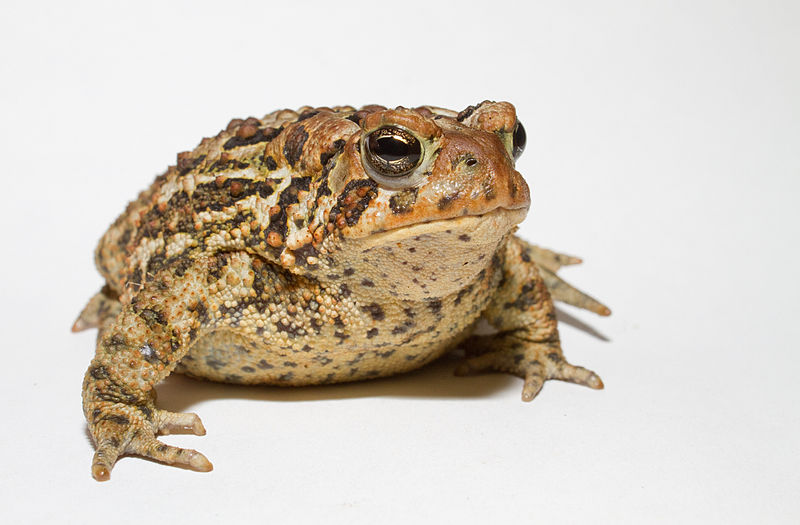
The American toad is mainly nocturnal and is most active when the weather is warm and humid. During the winter, the toad will burrow deep into the ground below the frost line. As the frost line gets deeper, the toads will burrow deeper beneath the ground. They can be found throughout the northern half of Mississippi.
Most American toads don’t survive more than a year in the wild, however some have lived to 10 years old. Captive raised, they have reached 36 years old. The toad has a high musical trill which can last upwards of 30 seconds. American toad is highly terrestrial and can only be found in the water for a short period while breeding and laying eggs. Below is a video that shows the American Toad calling.
Barking Treefrog (Hyla gratiosa)
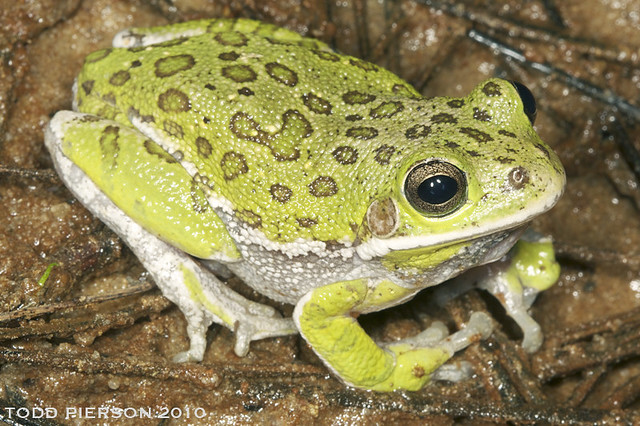
The Barking treefrog can reach 3″ in length. It is known for its bright green color with dark brown spots. It occurs in the southern third of Mississippi.
Their call is a loud ‘Tonk’ sound which from the distance the chorus can sound like barking dogs. Breeding lasts April- August and it is a polygamous species; with the female choosing the male based on his call. The barking treefrog can be found high within the treetops, but also burrowing within sand when temperatures get hot. Listen to their call below.
Bird Voiced Tree Frog (Hyla avivoca)
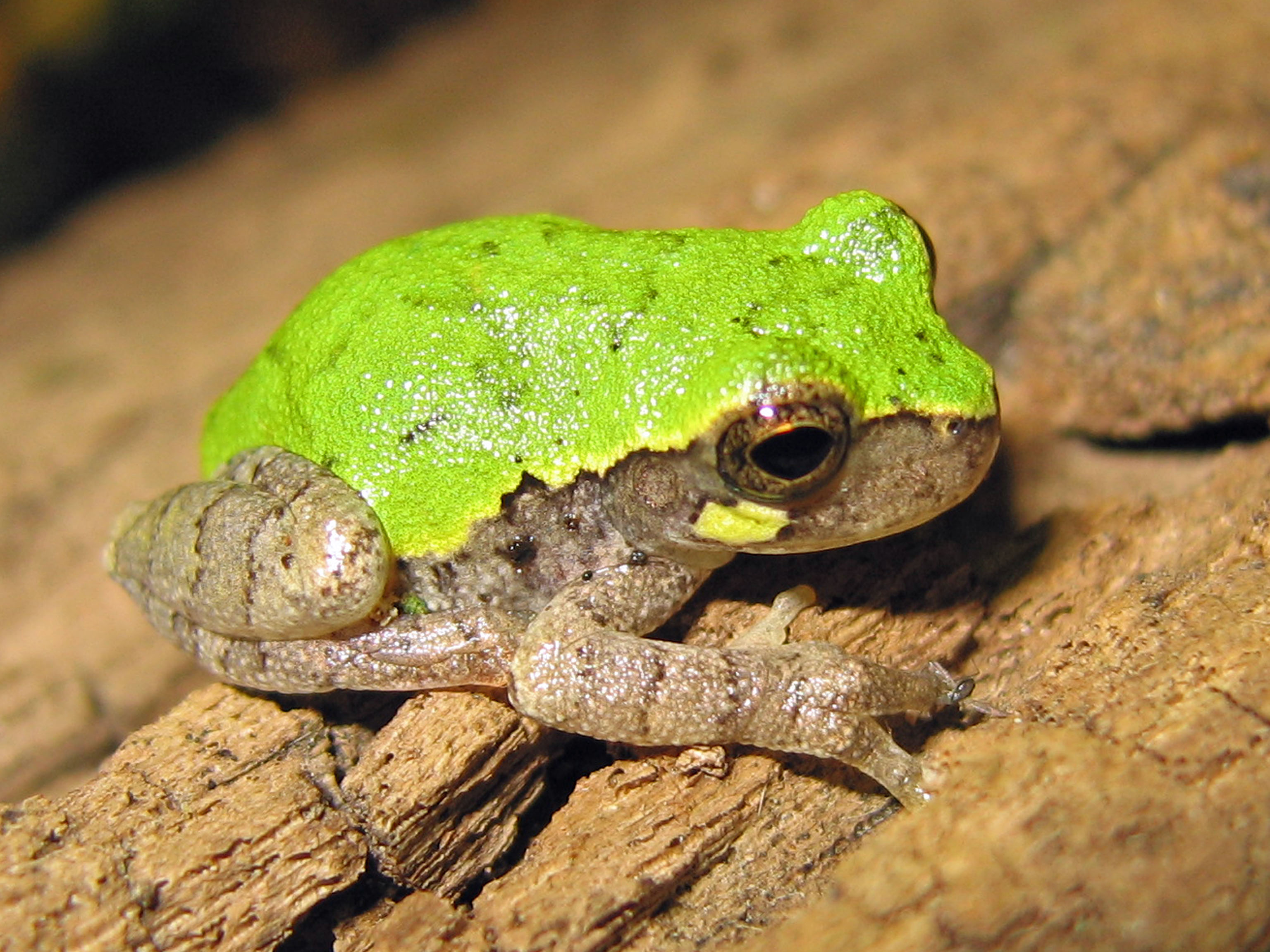
The Bird-Voiced treefrog is highly variable and can change colors, however it is typically shades of gray and green with yellow-green inside its legs. They have a distinctive white/ yellowish spot under their eye. They can be found in and around swamps and swampy lakes. They can be found statewide within Mississippi.

They breed from April-August using branches hung over water. Their call is very bird-like, hence the name, with 2-5 whistles per second. Listen to it below:
Cajun Chorus Frog (Pseudacris fouquettei)

The Cajun chorus frog can reach sizes of up to 1-1/4″. They have 3 broad dark stripes down their back and a white stripe along its upper lip. The frog is named in honor or M. J. “Jack” Fouquette of ASU – he was an expert in frog vocalizations. The cajun chorus frog can be found throughout Mississippi; typically found in open wetlands, flooded fields, etc.
The cajun chorus frog sounds like fingers running over a comb and can be heard February – April. Females lay 500-1,500 eggs in groups of 5-300. Tadpoles will become frogs within 6-8 weeks. In the winter, these frogs burrow into the ground and like wood frogs, they generate a type of antifreeze glycol to protect their organs. Listen to the call below.
Cope’s Gray Treefrog (Hyla chrysoscelis)
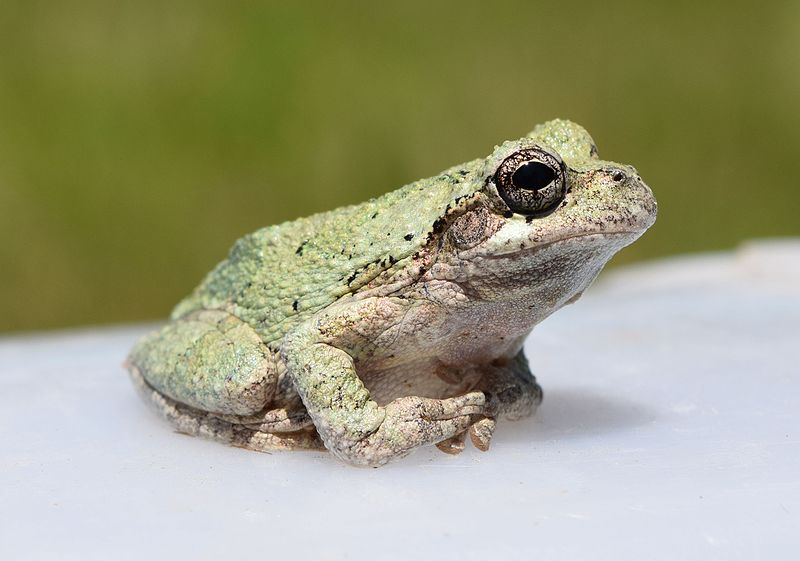
The Cope’s gray treefrog is smaller and smoother skinned than the gray treefrog. The gray treefrog and Cope’s gray treefrog can be difficult to tell apart during breeding while they are both mottled. However, most of the time the Cope’s gray treefrog has a solid lime green colored back. These frogs can be found statewide within Mississippi except for a couple scattered counties.

Cope’s gray tree frogs breed from April – August and can be heard calling between March and October. Another way the Cope’s gray treefrog can be distinguished from the gray treefrog is by its call. The Cope’s gray treefrog’s call is short and raspy. Listen to the video below to hear.
Crawfish Frog (Lithobates areolatus)
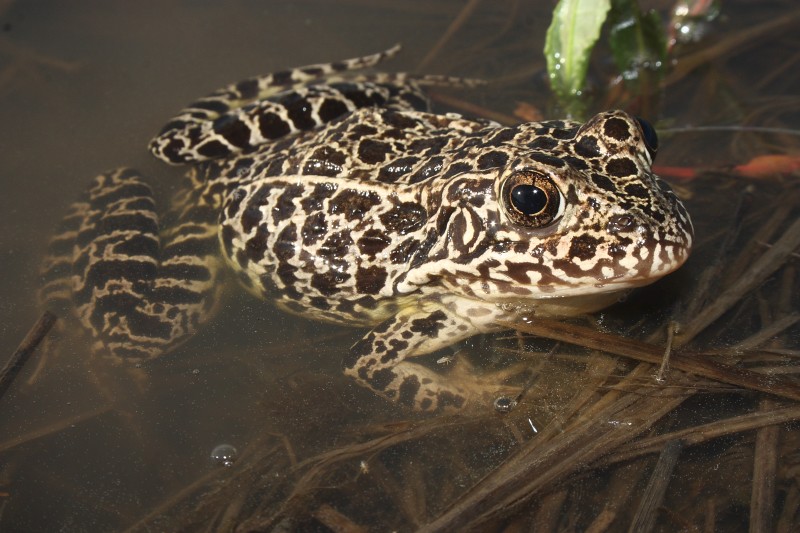
This frog has a large and stubby body with a distinct humped back while it rests. It is covered in many irregular shaped spots and its belly is solid white. It gets its name from its diet which consists of nocturnal beetles, small amphibians and reptiles and crawfish. The crawfish frog can be found in low lying areas including meadows, prairies, brush fields and crawfish holes. In Mississippi, it lives in the northern half of the state. However, it is rarely seen as it burrows underground. It is currently listed as Near Threatned by the IUCN red list and are close to meeting vulnerable species.
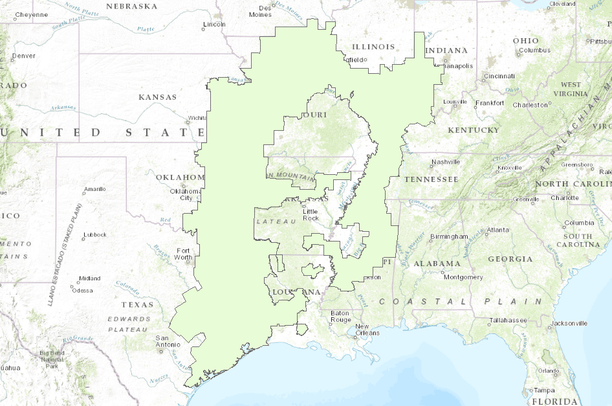
The crawfish frog breed from late February through April. The males will gather in a fishless pond and call. The females can lay up to 7000 eggs group in large 5-6″ clumps. The pond must maintain through mid-June while all of the froglets transform. The crawfish frog has a loud and deep call which reminds me of a hog. Listen to them below:
Cricket Frog (Acris crepitans)

The Cricket frog measures an average of 1″ in length with the females being slightly larger. These frogs can jump a surprisingly long way (5-6′) for their small size. They can range a combination of black, yellow orange or red on a base of brown or green. This frog can be throughout Mississippi. They may be found near permanent water sources like slow moving streams, margins of lakes and ponds or around marshy areas.
This frog was named for its breeding call which sounds very much like a chirp or trill of a cricket repeated for about 20 beats or like 2 pebbles clicked together. Listen to its call below.
Dusky Gopher Frog (Lithobates sevosus)

This frog has a large and stubby body with a distinct humped back while it rests. It is covered in many irregular shaped spots on its back and a mottled belly. The gopher frog can be found in wooded areas where it spends the daylight hours in burrows of other animals. In Mississippi, they can be found in a small portion in the extreme south of the state.

The gopher frog is an explosive breeder and all healthy adults breed at once. Females will lay egg masses of up to 7,000 eggs. The gopher frog has a very low snoring sound call which lasts for a few seconds. Listen to them below:
Eastern narrow mouth toad (Gastrophryne carolinensis)**
**Although it bears the name of “toad” it is actually considered to be a frog.
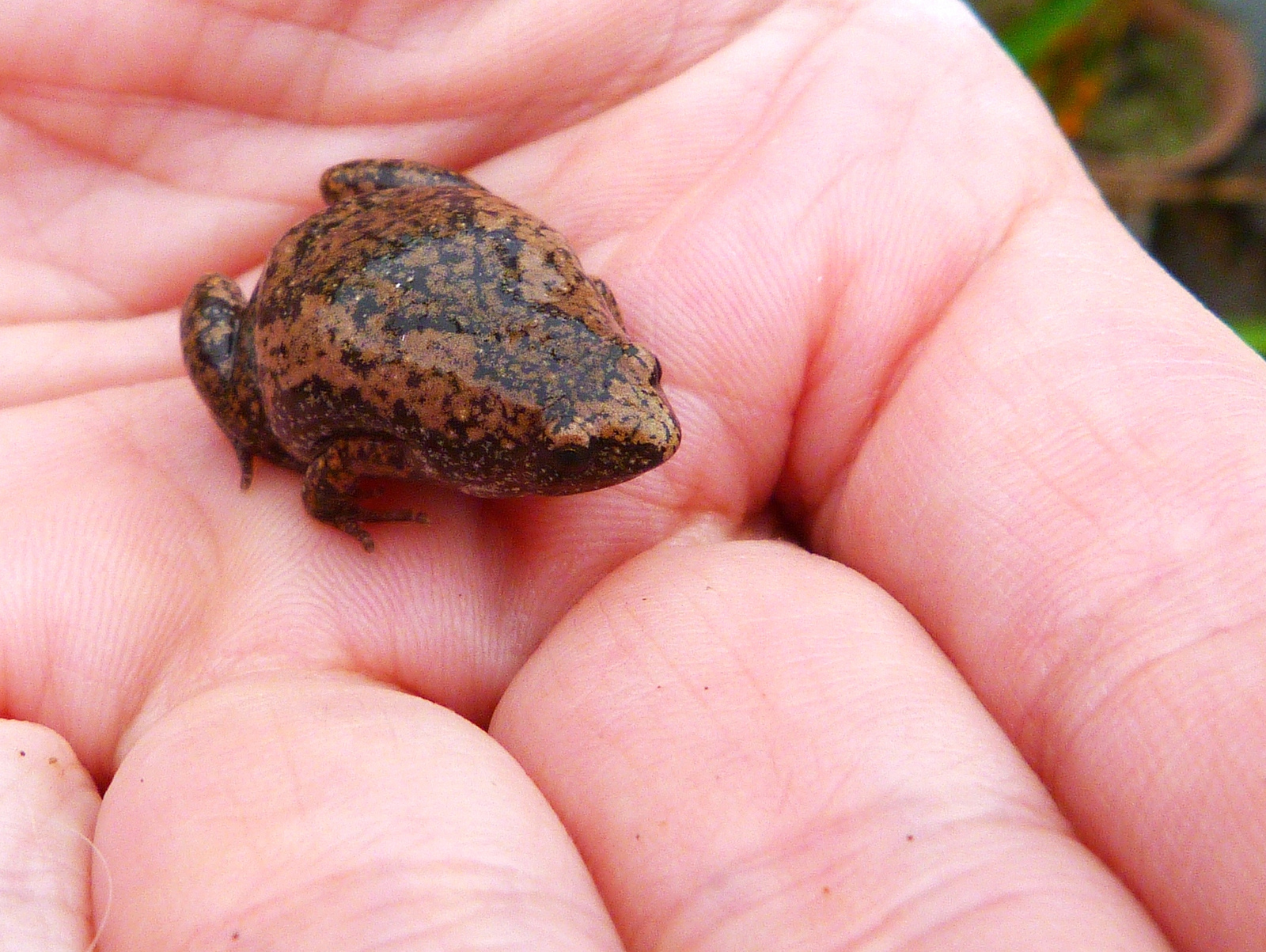
This frog is typically 1″ in length, with females being slightly larger. One defining characteristic of this frog is the fold of skin on the back of the frogs head. The eastern narrow mouth toad is grey or brown in color with smooth thick skin. It can be found in grassy areas on rocky slopes and in rock filled canyons. They will hide under rocks and can sometimes be found with tarantulas. As shown in the photo below, they can be found across the state of Mississippi.

The male eastern narrow mouth toad’s belly will create a substance that will stick the mating pair together. The female will lay up to 850 eggs on the surface of the water. They will take 2 days to hatch and will be toadlets within a quick 30-60 days. It’s call sounds similar to a bleating sheep with a baaaaa. Several calling frogs together sound like bees or a bunch of toy airplanes. I was very surprised by the pitch of their call. Have a listen below:
Eastern Spadefoot (Scaphiopus holbrookii)
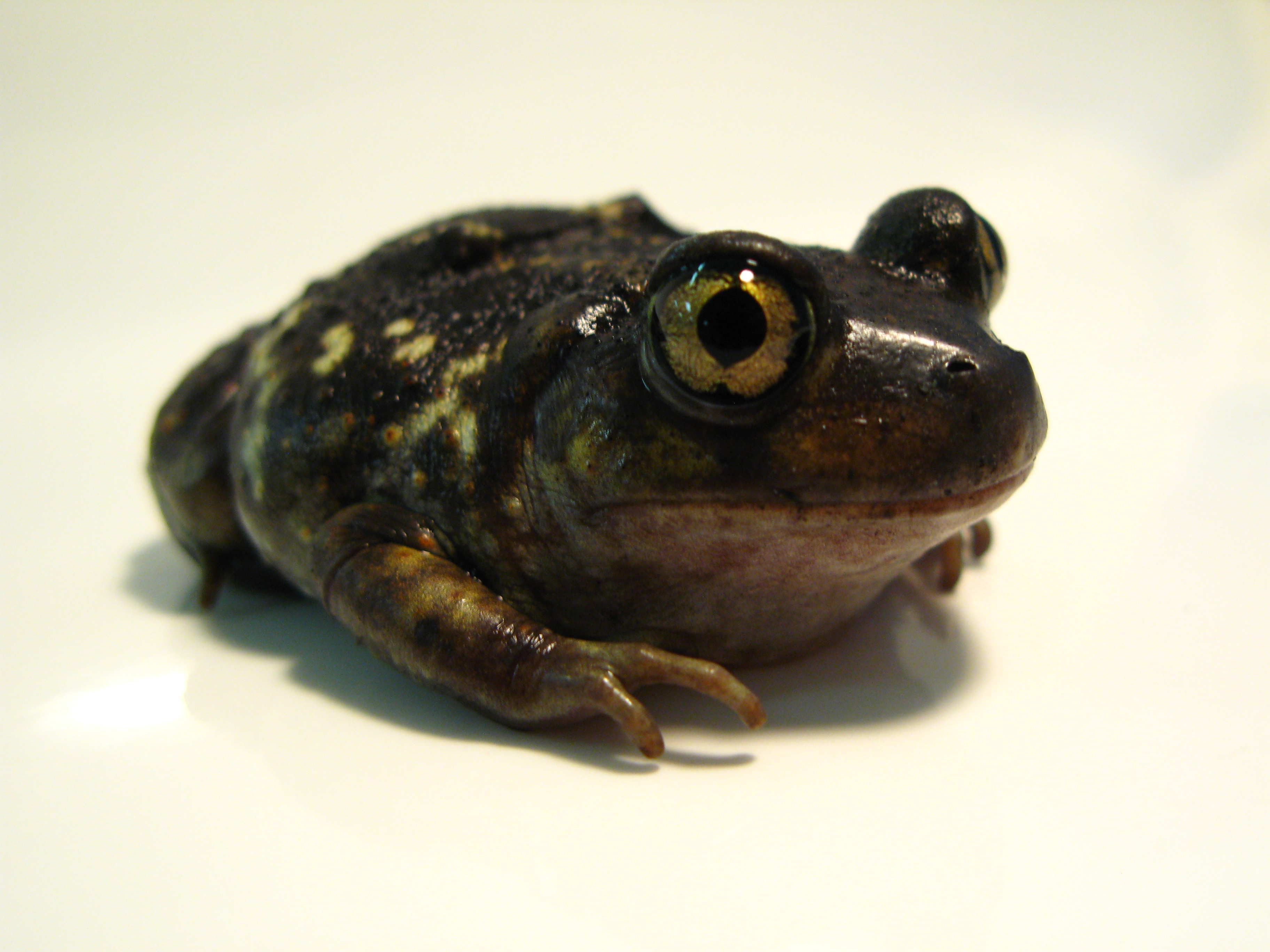
The Eastern Spadefoot has smoother and more moist skin than most toads and is speckled with very tiny warts. This species typically had a light brown to yellow brown color mottled with dark brown. The back of the eastern spadefoot may be dark brown with exception of a couple light yellow stripes. The lines are usually more visible in males. The Eastern Spadefoot has a vertical pupil in the eye similar to a cat. They can be found in the sandy soil along the floodplains of streams and rivers. The Eastern Spadefoot prefers dry habitats with sandy soil, but will breed in flooded fields or ditches in warm rainy weather. They can be found across the state of Mississippi.

These spadefoots spend almost all of their time buried under ground, with the exception of breeding time. During breeding time, the spadefoots emerge from their burrows and the male will let out a short explosive “wank” call which sounds like a call of a crow. Something odd about these guys is that some people believe that the Eastern spadefoot smells like peanut butter.
Fowler’s Toad (Anaxyrus fowleri)

The Fowler’s toad is usually brown, grey, olive green and rust red in color with darkened warty spots. As these toads become adults, a pale stripe will form down its back. The belly is usually white-ish with one dark spot. These toads are found throughout Mississippi.

This toad has a long, loud, high pitched W-A-A-A-H-H-H call. Listen to it in the video below! It is said that they can be mistaken for a herd of sheep calling in the night. The Fowler’s toad will make a series of quick, short hops as the American toad will make a few larger hops. The Fowler’s toad will amplexus in March – August. The female can release 7,000 -10,000 fertilized eggs which will hatch 2-7 days later.
Green Frog (Lithobates clamitans)
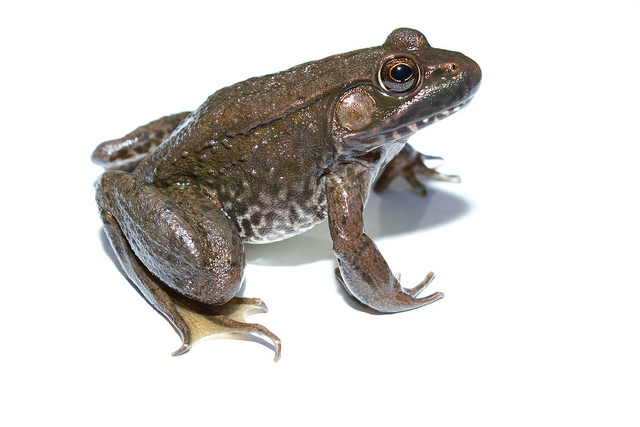
The green frog is typically greenish-brown with dark mottling on its head, chest and under its legs. The throat color ranges to yellow for a male to white for the females. The green frog is similar to the bullfrog, however the bullfrog is larger and lacks the skin fold behind the eye to mid torso. The Green Frog is seen nearly statewide.
These frogs can produce as many as 6 different calls – however the most distinctive sound is a throaty boink that sounds like a loose banjo string being plucked. Listen to the video below to hear!
Green Treefrog (Hyla cinerea)

The green treefrog is slender frog that ranges from bright green to dull green with a white stripe down its side. These frogs can reach 2.5″ and can be easily frightened. They are typically found within marshes, swamps, small ponds and streams, but can also be found within brackish water sources. They can be found statewide within Mississippi.
On average, a female will lay 400 eggs. Breeding takes place April – August. It has been noted that the green treefrog will choose its prey not based on size, but based on activity level. With the most active being eaten first. The male’s call is a single note repeated over and over sounding like a “queenk”. Listen to their call below.
Gulf Coast Toad (Incilius nebulifer)
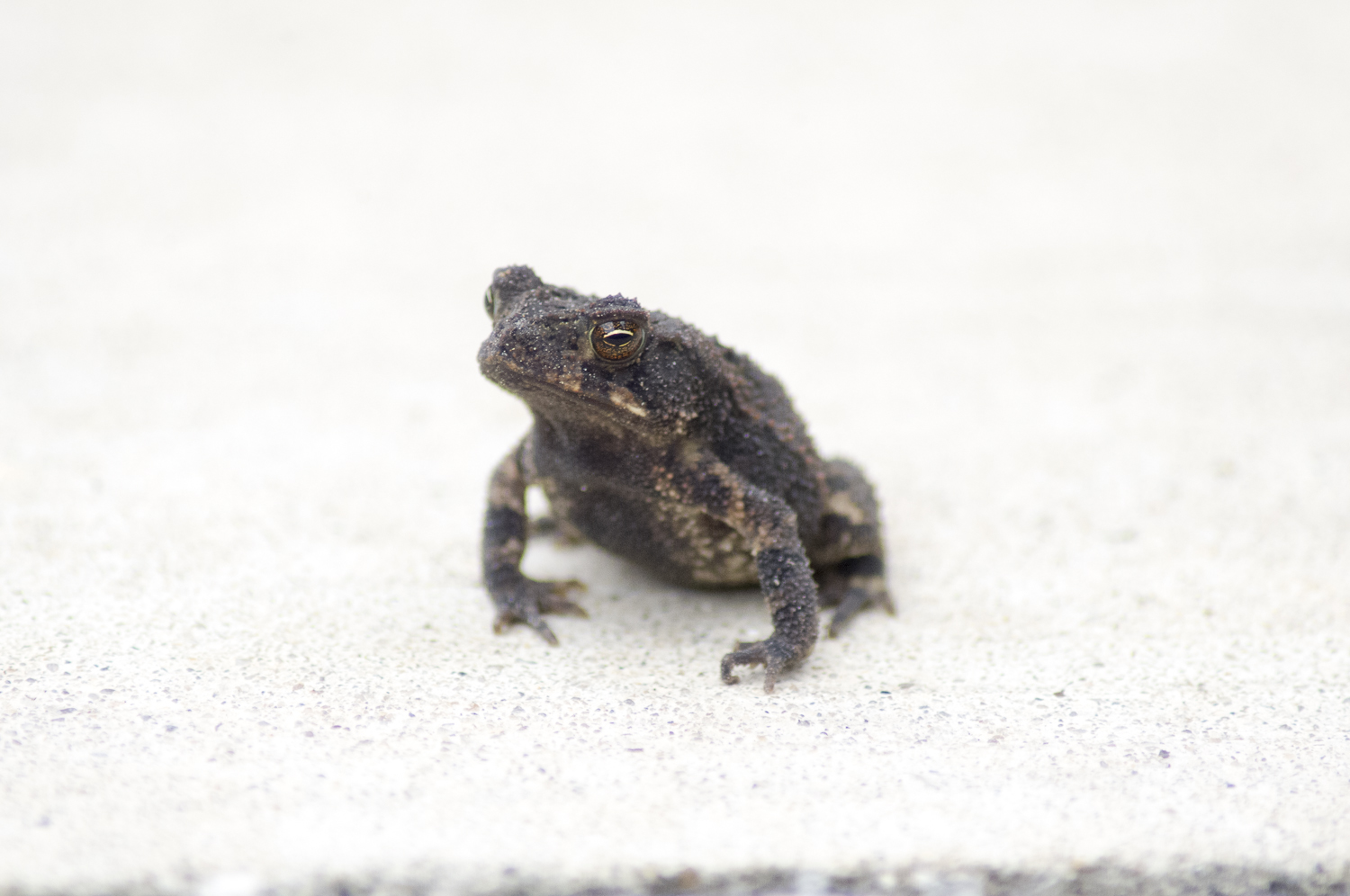
The gulf coast toad is the largest toad native to the southeastern United States – reaching up to 5″, but are typically closer to 3″. They will have a uniform brown body with a white stripe along each side of the body and down the middle of its back. They are typically found in warm and moist habitats. They are considered salt tolerant as they can be found in the middle of coastal brackish marshes. In Mississippi, they can be found scattered in a few southern counties.

The Gulf Coast toad females have been known to lay up to 5,000 eggs! The males call is a low-pitched trill lasting 2-6 seconds. It can be heard early to mid-spring.
Mountain Chorus Frog (Pseudacris brachyphona)
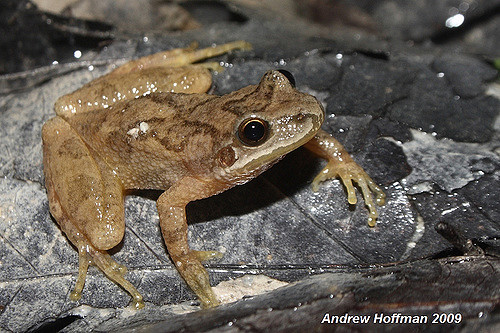
The mountain chorus frog is a small species which ranges from tan to light brown with a dark brown mottling pattern. This species is not associated with water and is typically found near woodlands. The mountain chorus frog can be in the northeastern corner of the state of Mississippi.

The mountain chorus frog has a high pitched call which sounds similar to a fire alarm. Listen to the call below!
Oak Toad (Anaxyrus quercicus)

The Oak Toad is the smallest toad in North America – reaching 1.75″ in length. They are so small that they were originally classified as half-grown southern toads. They are typically black or brown in color with a white, cream or yellow stripe on the back. They have 4-5 pairs of dark colored blotches on the back as well. The bumps on their back tend to have a red, orange or brown color which gives it a rough texture. Their stomach is grayish white. They can be found in grassy areas or areas with sandy soil or freshwater wetlands. In Mississippi, they are found in the southernmost counties.

The oak toad has a chirping call which can be heard from April – July. The females will lay 300-500 eggs in a strand attached to grass. The call can be heard below:
Ornate chorus frog (Pseudacris ornata)

The Ornate Chorus frogs are small reaching up to 1.5″. Their color can range from gray, green and a reddish brown color. They wear a black mask-like stripe across their eyes and may have a yellow coloring in their groin area. They can be found in grassy areas, woodlands and wetlands. Within Mississippi, they can be found in the southern most counties.

The ornate chorus frog is nocturnal and can be heard from December to march. Females can lay up to 1000 eggs in shallow water. The call of the males is a sharp metallic tink repeated often. Have a listen to it below:
Pickerel Frog (Lithobates palustris)

The Pickerel frog looks very similar to the Northern Leopard frog; however the pickerel frog has 2 parallel rows of squareish spots down its back. They are often found near beaver ponds with dense vegetation. The pickerel frog may be found throughout most of Mississippi as shown below.

Female pickerel frogs lay between 700-2,900 eggs in a globular mass attached to a submerged stick or stem. The tadpoles will transform into frogs around mid-July based on water temperature. As a defense the skin of the pickerel frog produces a toxic substance which makes them unappealing to most predators. Listen to the video below to hear their call. It sounds similar to a low and slow snore.
Pig Frog (Lithobates grylio)
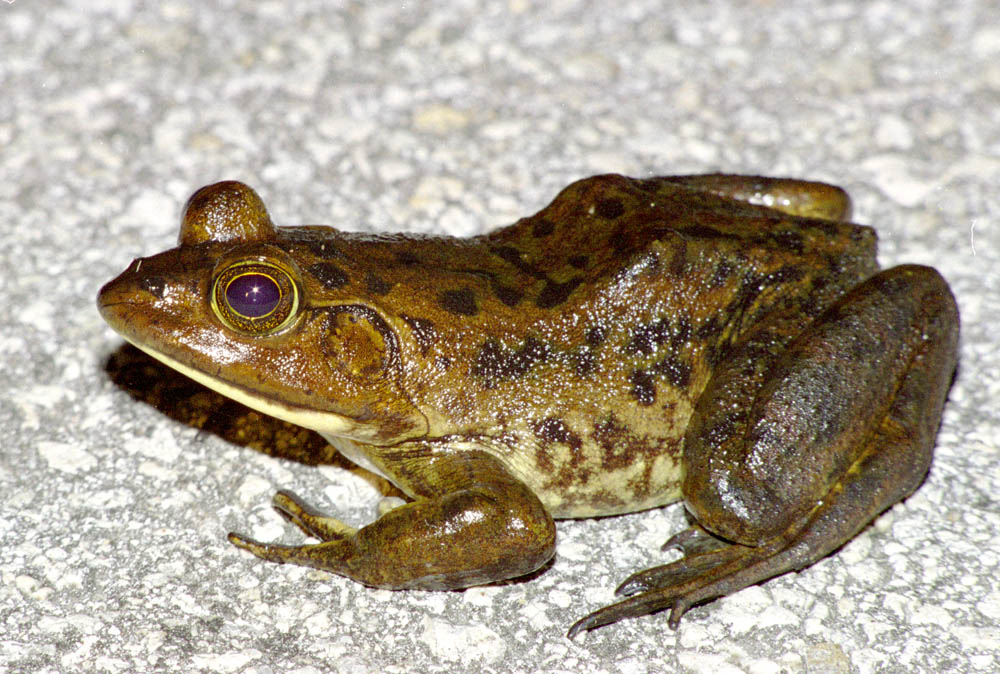
The pig frog is a large frog that can reach up to 6″ long. It’s body can range from greenish to brown to black with large irregular spots. The belly is white to cream. One distinguishing feature is the back of the thighs are boldly marked with light stripes or spots. The American bullfrog is similar in appearance however the back of its thighs have small abundant light spots. The pig frog can be found scattered throughout southern Mississippi.
Breeding occurs in March to September in quiet ponds, canals and prairies. The female lays eggs in a large surface film over vegetation. The male’s call sounds like a pig grunt. Listen to them below:
Pine woods Treefrog (Hyla femoralis)

The Pinewoods treefrog is around 1.5″ in length and can range from brown-gray to red-brown to gray-green color with dark mottlings on its back and small orange or yellowish spots on the rear of its thigh. They can be found high in trees but also at ground level in rotten logs or crevices in trees. It can be found in the southern half of Mississippi.

The males are nicknamed the “Morse-code frog” as their call consists of sporadic chattering. It can be heard from April – August. Listen to its call below:
River Frog (Rana heckscheri)
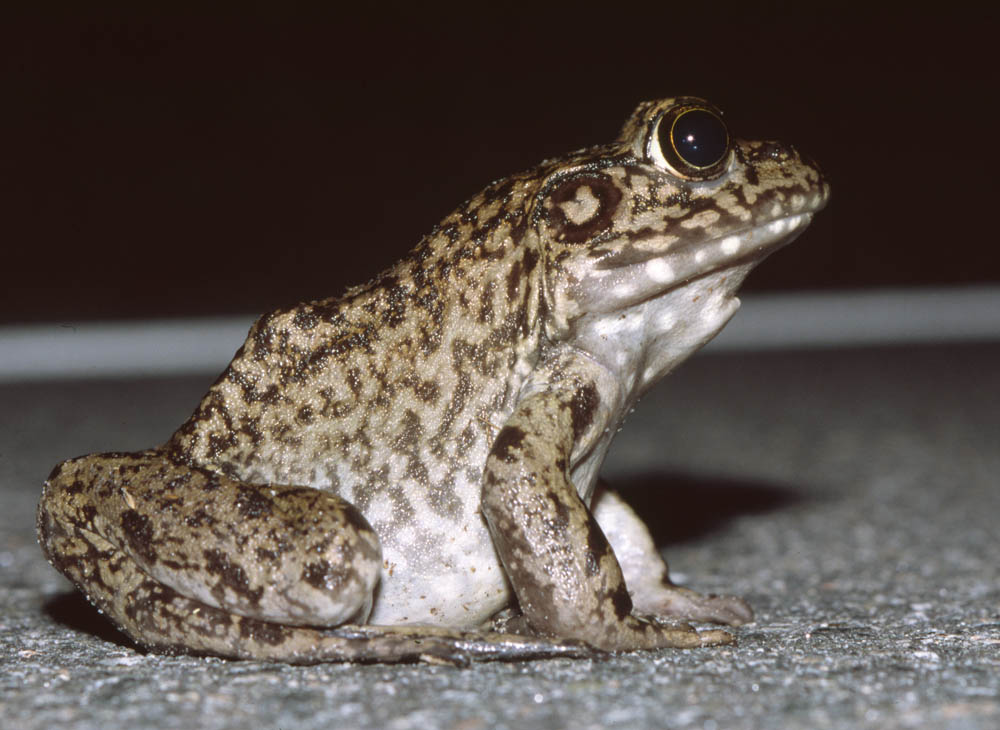
The river frog has a greenish black back with warty and wrinkled skin. The belly has net like markings. Lips are marked with light spots. The American bullfrog is similar in appearance however the river frog’s belly is dark with light spots as the bullfrogs belly is light with dark markings. These frogs can be found in the southern most counties of Mississippi near swamps, lakes and near river edges.

The female will lay her eggs on a surface film between April & August. The males call sounds like a grunt and a snore at the same time. Listen to it below:
Southern Chorus Frog (Pseudacris nigrita nigrita)
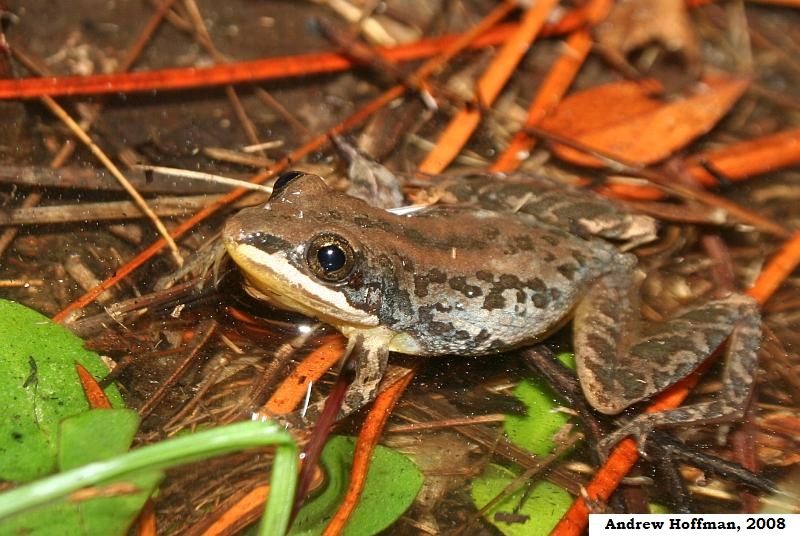
The southern chorus frog typically has a whiteish-grey to tan back with dark broken lines of spots. A light line is visible on the upper lip. These frogs can reach up to 1.25″ in length. They can be found in the southern portion of Mississippi and are typically burrowed in the loose sandy soils near sandhills, flooded ditches and fields.

These frogs can breed November to April. The female will lay clusters of around 15 eggs. The male’s call is a repeated trill. The males will typically call from a well concealed location so they may be hard to find.
Southern Leopard Frog (Lithobates sphenocephala)
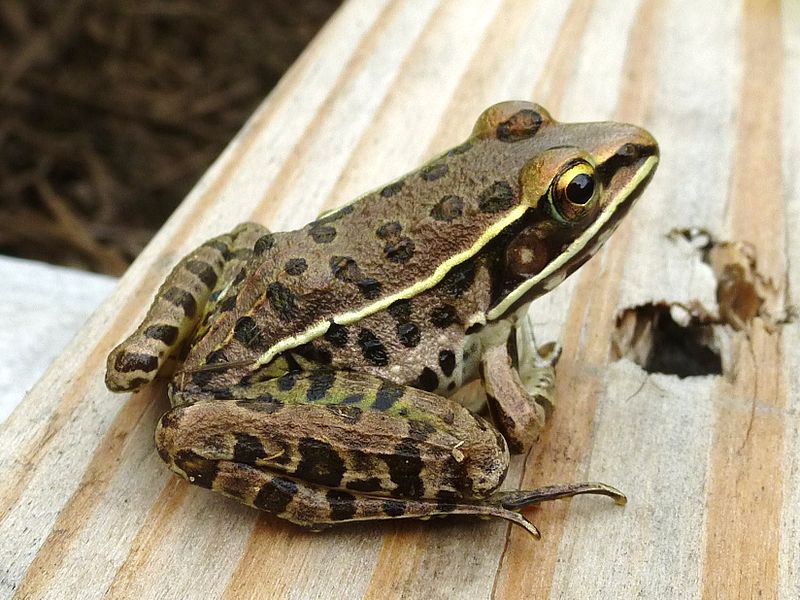
The Southern Leopard frog has 2-3 unevenly spaced rows of irregular oval shaped dots on its back. The southern leopard frog has been found statewide within Mississippi. It needs 3 different habitats to match its lifestyle – permanent water for overwintering, floodplains & marshes for breeding & meadows and fields for foraging.
These frogs are opportunistic feeders, meaning that they will eat anything that fits in their mouth including beetles, ants, smaller frogs – including their own species, birds and even garter snakes. It’s call is like a low and rumbling snore and grunt sound. It has also been known to scream loudly when grasped or frightened by a predator. Listen below to their call.
Southern Toad (Anaxyrus terrestris)
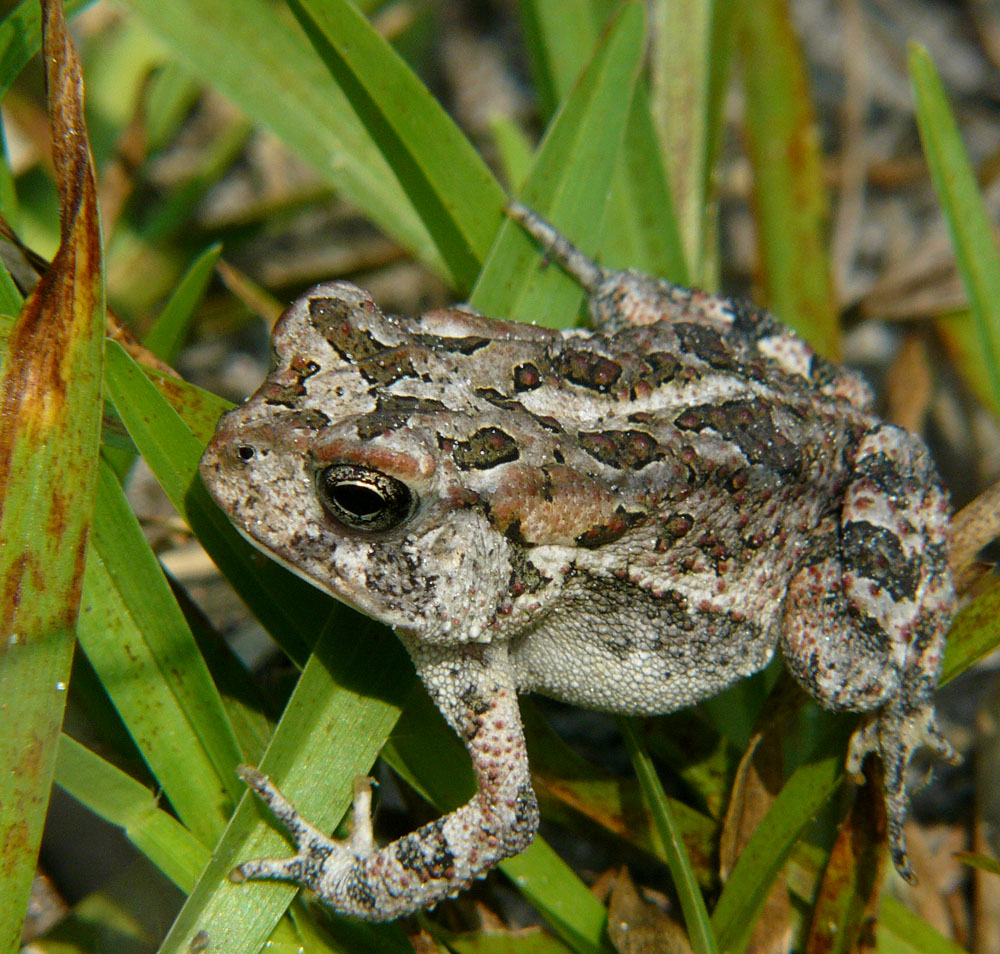
The southern toad is typically 3″ in length and is more often brown, but can be black, grey or red. It lives in areas with sandy soils and spends its days in its burrow. It can be found in the southern portion of Mississippi.

Breeding occurs in spring when males migrate from their upland habitats to the swamps, ditches and pools to breed. Each female may lay up to 4,000 eggs which will take up to 55 days to morph into juvenile frogs. Listen to the males call below:
Spring Peeper (Pseudacris crucifer)
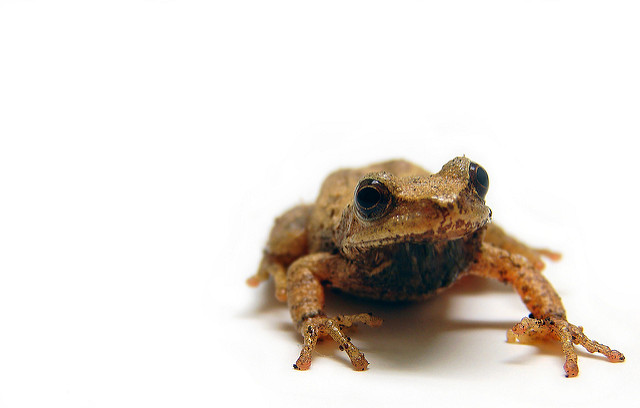
The spring peeper measures from 3/4″ to 1-1/4″. It can be distinguished by it’s dark colored “X”across its back. This frog is common throughout most of Mississippi; in woods next to vegetated swamps and marshes.

It’s chorus of a shrill high pitched call can be heard from up to a 1/2 mile away! Listen to its call in the video below. The peeper is one of the earliest frog species to breed in the area beginning as early as late December during warm spells. Similar to the American toad, these frogs spend most of its time on land and only are in the water to breed and lay eggs. Like most tree frogs, the spring peeper is nocturnal and loves to hunt ants, spiders and other small insects during the evening.
Squirrel Treefrog (Hyla squirella)

The squirrel treefrog is usually green, but can be brown or tan with numerous spots. A yellowish cream stripe runs along their side. The underside of their legs may have yellow. They can be found in flooded areas, fishless ponds and shallow pools. Within the state of Mississippi, they can only be found in the southern half of the state.

The squirrel treefrog breeds from April to August, but the call can be heard as late as September as it is associated with heavy rainfall and warm temperatures. The breeding call is a hoarse quack which sounds similar to a mallard duck. Listen to it below:
Thanks for reading! Check out all of the United State’s native frogs and toads here.
Photo Credits:
Cover photo used by the creative commons license. Text was added. See Original photo by Charlie Brenner here.
- Photo from Wikimedia Commons used under the Creative Commons license. Photo taken by Brian Gratwicke. Original Photo Here.
- Photo from Wikimedia Commons used under the Creative Commons license. Photo taken by Brian Gratwicke. Original Photo Here.
- Photo from Flickr Wikimedia Commons used under the Creative Commons license. Photo taken by Todd Plerson. Original Photo Here.
- Photo from Flickr Wikimedia Commons used under the Creative Commons license. Photo taken by Greg Schechter. Original Photo Here.
- Photo from Wikimedia Commons used under the Creative Commons license. Photo taken by Jeromi Hefner. Original Photo Here.
- Photo from Wikimedia Commons used under the Creative Commons license. Photo taken by Fredlyfish4. Original Photo Here.
- Photo from Flickr Wikimedia Commons used under the Creative Commons license. Photo taken by Andrew Hoffman. Original Photo Here.
- Photo from Wikimedia Commons used under the Creative Commons license. Photo taken by Andy Reago & Chrissy McClarren. Original Photo Here.
- Photo from Flickr Wikimedia Commons used under the Creative Commons license. Photo taken by U.S. Department of Agriculture. Original Photo Here.
- Photo from Flickr Wikimedia Commons used under the Creative Commons license. Photo taken by Rusty Clark. Original Photo Here.
- Photo from Connecticut Department of Energy & Environmental Protection. Original photo here.
- Photo from Wikipedia Commons used under the Creative Commons license. Photo taken by Perlick Laura. Original Photo Here.
- Photo from Flickr Wikimedia Commons used under the Creative Commons license. Photo taken by Brian Gratwicke. Original Photo Here.
- Photo from Flickr Wikimedia Commons used under the Creative Commons license. Photo taken by Jarek Tuszynski. Original Photo Here.
- Photo from Flickr Wikimedia Commons used under the Creative Commons license. Photo taken by ilouque. Original Photo Here.
- Photo from Flickr Wikimedia Commons used under the Creative Commons license. Photo taken by Andrew Hoffman. Original Photo Here.
- Photo from Flickr Wikimedia Commons used under the Creative Commons license. Photo taken by Bob Peterson. Original Photo Here.
- Photo from Flickr Wikimedia Commons used under the Creative Commons license. Photo taken by Peter Paplanus. Original Photo Here.
- Photo from Wikimedia Commons used under the Creative Commons license. Photo taken by Brian Gratwicke. Original Photo Here.
- Photo from Flickr Wikimedia Commons used under the Creative Commons license. Photo taken by Tom Spinker. Original Photo Here.
- Photo from Flickr Wikimedia Commons used under the Creative Commons license. Photo taken by Judy Gallagher. Original Photo Here.
- Photo from Flickr Wikimedia Commons used under the Creative Commons license. Photo taken by Tom Spinker. Original Photo Here.
- Photo from Flickr Wikimedia Commons used under the Creative Commons license. Photo taken by Andrew Hoffman. Original Photo Here.
- Photo from Wikimedia Commons used under the Creative Commons license. Photo taken by Bob Warrick. Original Photo Here.
- Photo from Flickr Wikimedia Commons used under the Creative Commons license. Photo taken by tom spinker. Original Photo Here.
- Photo from Flickr Wikimedia Commons used under the Creative Commons license. Photo taken by Matt Reinbold. Original Photo Here.
- Photo from Wikimedia Commons used under the Creative Commons license. Photo taken by Judy Gallagher. Original Photo Here.
Like “The Frog Lady” on facebook or follow aapanaro on instagram to get some sneak peeks into the frog lady’s frog room!


 The Frog Lady
FINALLY I have a great resource to id the smorgasbord of frogs & toads on our property & lake. I’m gonna join your FB page for more info. These little critters amaze me. We rescued around 1000 from our swimming pool when we reopened it and put them in a large fountain (no chlorine & it wasn’t turned on). Now we are seeing itty bitty froggies EVERYWHERE. Living in the country, I love listening to them along with all the other “musicians” out there.
I found a frog last night I cannot identify. It was about 1 1/2 inch long solid muddy brown no markings. It was slimy or jelly looking. I didn’t have my phone with me so I didn’t get a pic. It was getting dark and I couldn’t find it again. What kind could it be. I live in Summit,Ms. Thanks
I found a small frog that was rescued from our pool. It has a distinct lime green stripe down the center of its back that splits and forks off to a point behind each eye.
There is another somewhat triangular marking from the snout extending up between the eyes. I can send you a picture if you can help me identify it. It doesn’t look like any of the other frog pictures that I have seen.
You can send a message via the contact tab and I will reply via email. Otherwise, take a look at the Southern Cricket frog.
Thank you. We agree with you that it is a cricket frog. Still not quite sure about the species.
I had a container garden this year. There were so many brown baby frogs but what suprised me were the red baby frogs. I’m in north Mississippi right below Memphis. Have you heard of this?
Would you like to be the guest speaker for the Clinton Community Nature Center Educational Lecture Series.
We are looking for a July speaker. Usually scheduled for the 4th Thursday at 6pm (July 27), but this is flexible.
I found you looking for resources for my preschool program.
Clinton Community Nature Center, Clinton, MS
Please email: Ccnaturecenter@gmail.com if you are interested in this opportunity.
I have a picture of a frog in southern MS that I’m having trouble identifying. Is there a way for me to send you the picture? I *think* it’s a Southern Cricket Frog with reddish coloring. The red isn’t something we usually see!