***This post is a part of my series where this year I will be highlighting all of the different states native frogs and toads. Check out this page to see all of the United State’s native frogs broken down by state. ***
Read more below about the frogs and Toads that can be found in Nebraska below:
American Bullfrog (Lithobates catesbeianus)
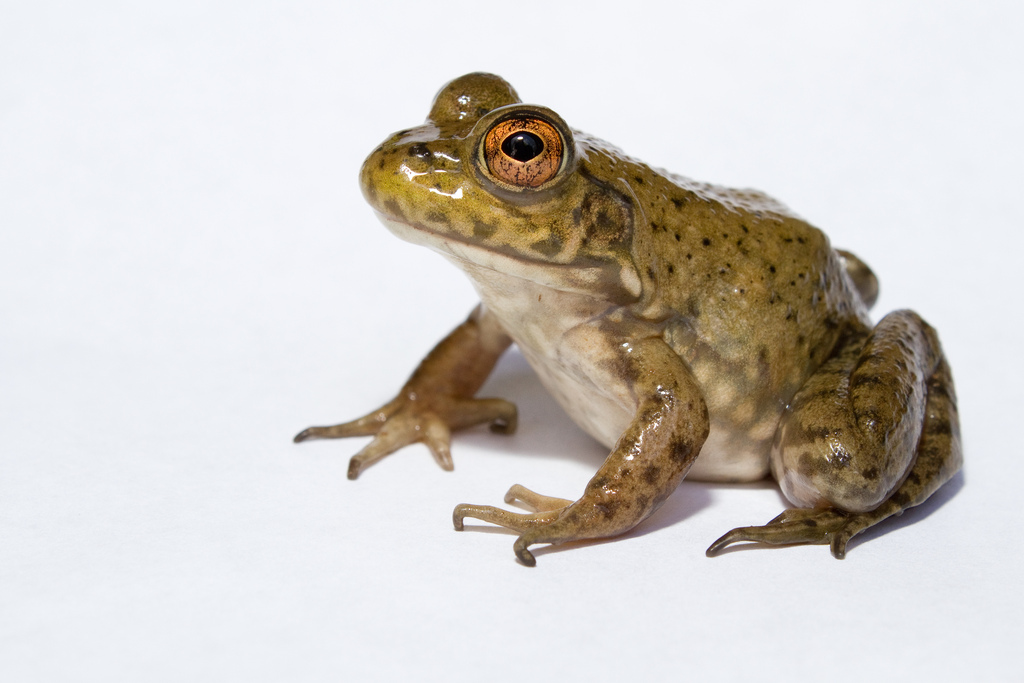
Photo 1
The American Bullfrog is the largest frog in North America. They are typically green or gray-brown with brown spots. They can grow up to 8″ in length and weigh up to 1.5 pounds. The bullfrog can be found near large permanent bodies of water with vegetation near the shorelines. They can be found almost statewide, but they were introduced throughout Nebraska and are seen as an invasive amphibian.

It has a very deep call which resembles the mooing of a cow. Watch the video below to hear! Both genders of the bullfrog croak. Their calls may be heard day or night between June-July.
Northern Leopard Frog (Lithobates pipiens)
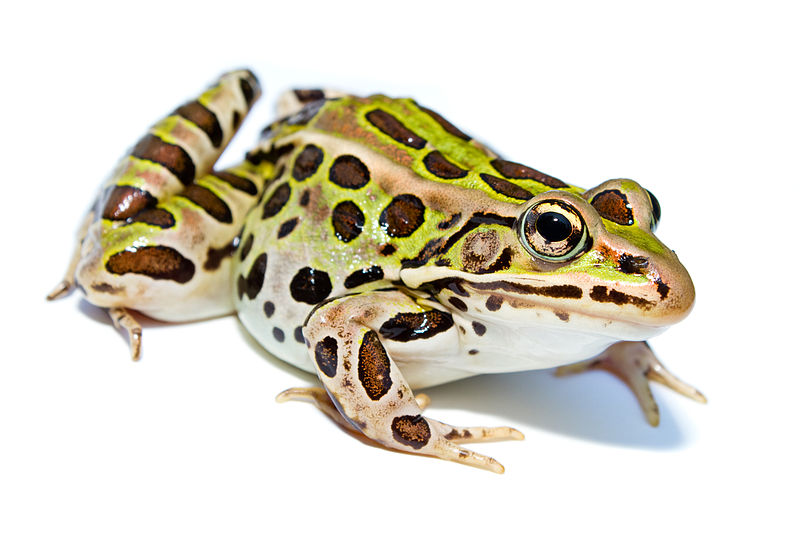
Photo 2
The Northern Leopard frog has 2-3 unevenly spaced rows of irregular oval shaped dots on its back. The northern leopard frog can be found in the northern 2/3rds of Nebraska. It needs 3 different habitats to match its lifestyle – permanent water for overwintering, floodplains & marshes for breeding & meadows and fields for foraging.

These frogs are opportunistic feeders, meaning that they will eat anything that fits in their mouth including beetles, ants, smaller frogs – including their own species, birds and even garter snakes. It’s call is like a low and rumbling snore and grunt sound. It has also been known to scream loudly when grasped or frightened by a predator. Listen below to their call.
American Toad (Anaxyrus americanus)
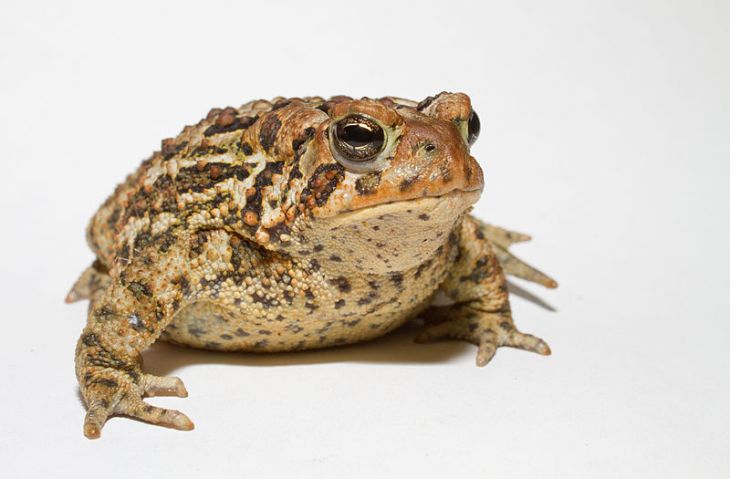
Photo 3
The American toad is mainly nocturnal and is most active when the weather is warm and humid. During the winter, the toad will burrow deep into the ground below the frost line. As the frost line gets deeper, the toads will burrow deeper beneath the ground. They can be found in the extreme eastern portion of Nebraska along the Missouri river. They love the moist areas in forests, fields and residential areas but can be found anywhere that has enough moisture and bugs.

The toad has a high musical trill which can last upwards of 30 seconds. American toad is highly terrestrial and can only be found in the water for a short period while breeding and laying eggs. Below is a video that shows the American Toad calling.
Blanchard’s Cricket Frog (Acris blanchardi)
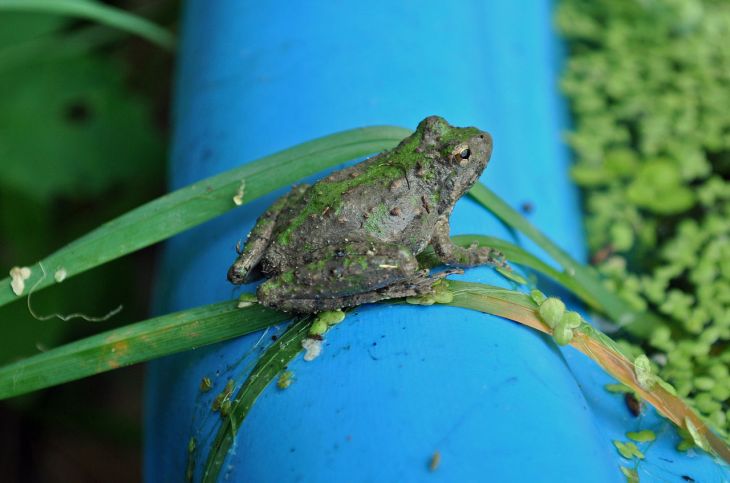
Photo 4
The Blanchard’s cricket frog is a small treefrog that’s skin color is quite variable. The skin color can range from brown, green,grey or reddish tan and may change based on environmental conditions. The cricket frog can be found in the eastern 2/3rds of Nebraska. They can be found near ponds, lakes and adjacent streams and tend to breed in quiet water.

Tadpoles typically have a distinct black tipped tail and can reach 1.9″ in length. Breeding occurs between late-March thru late-July. The Blanchard crickets call resembles the sound of 2 ball bearings clinking together. Listen to the video below to hear them!
Boreal Chorus Frog (Pseudacris brachyphona)
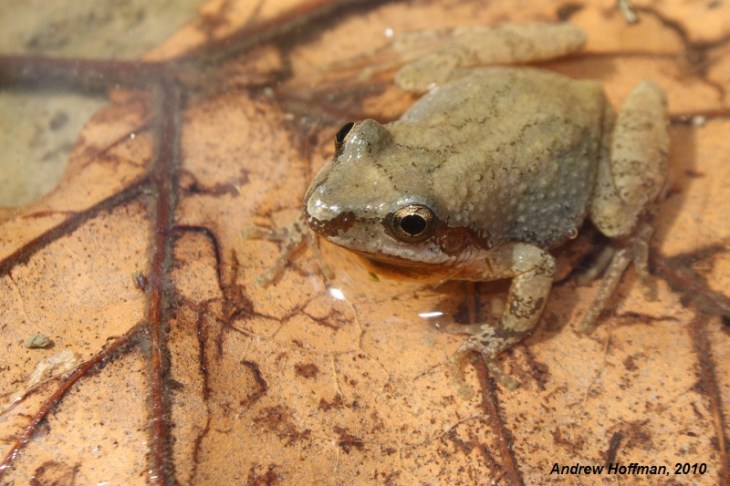
Photo 5
The Boreal Chorus frog is brown with 3 dark lateral stripes or spots down its back with a white upper lip and measures only 1″ long. The species can be found throughout Nebraska.
The boreal chorus frog sounds similar to the spring peeper in that it sounds like fingers running over a comb, however the boreal chorus frog’s call is more tinny and mechanical opposed to the musical whistle of the spring peeper. Females lay 500-1,500 eggs in groups of 20-300. Listen to the call below.
Cope’s Gray Treefrog (Hyla chrysoscelis)
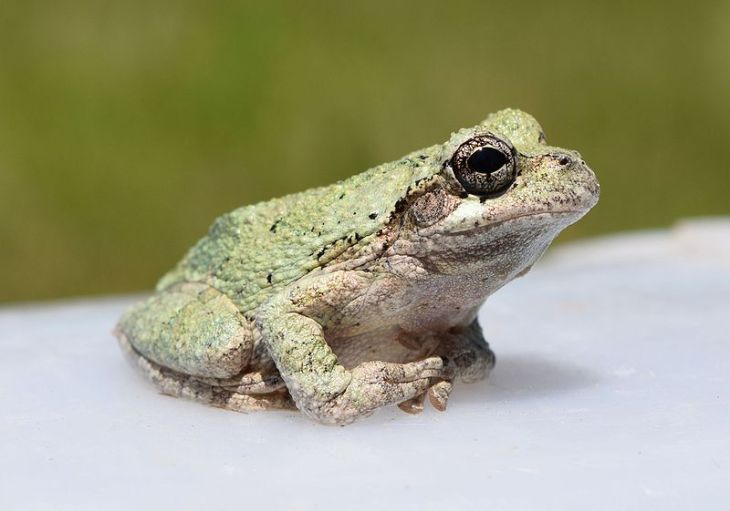
photo 6
The Cope’s gray treefrog is smaller and smoother skinned than the gray treefrog. The gray treefrog and Cope’s gray treefrog can be difficult to tell apart during breeding while they are both mottled. However, most of the time the Cope’s gray treefrog has a solid lime green colored back. These frogs are common near bodies of water in the eastern corner of the state of Nebraska. 
Another way the Cope’s gray treefrog can be distinguished from the gray treefrog is by its call. The Cope’s gray treefrog’s call is short and raspy. Listen to the video below to hear.
Western narrow mouth toad (Gastrophryne olivacea)**
**Although it bears the name of “toad” it is actually considered to be a frog.

Photo 7
This frog is typically 1.5″ in length, with females being slightly larger. One defining characteristic of this frog is the fold of skin on the back of the frogs head. The great plain narrow mouth toad is grey or brown in color with smooth thick skin. It can be found in grassy areas on rocky slopes and in rock filled canyons. They will hide under rocks and can sometimes be found with tarantulas. As shown in the photo below, they can be found in the extreme south of Nebraska, but are generally scarce.

The great plains narrow mouth toad’s call is a nasal buzz lasting only 1-4 seconds. Several calling frogs together sound like bees or a bunch of toy airplanes. I was very surprised by the pitch of their call.
Plains Leopard Frog (Rana blairi)

Photo 8
This frog is brown with large rounded dark spots with light borders. As you can see from the photo above, the ear drum is very distinct. The plains leopard frog can reach 3″. They can be found near streams, ponds, creeks and ditches. In wet, mild weather, they may be found far away from water. In Nebraska these frogs can be found in the eastern 2/3rds of the state.
The plains leopard frog’s call includes a few low grunting sounds along with a series of short clucks. Listen to their call below:
Great Plains Toad (Bufo cognatus)

Photo 9
The Great Plains Toad has numerous warts and prominent ridges on its head. The females will typically reach 4.5″ with males being less than 4″. They can be found in grasslands, sandhills and semi-desert shrubland. The Great Plains narrow mouth toad can be found throughout Nebraska with exception of the western corner as seen below.

The Great Plains toad has a long trill call that lasts several seconds long and can vary depending on the size of the male and the temperature. Some people have compared this toad’s call to a jackhammer, but go ahead and listen to it for yourself below:
Woodhouse’s Toad (Bufo woodhousii)
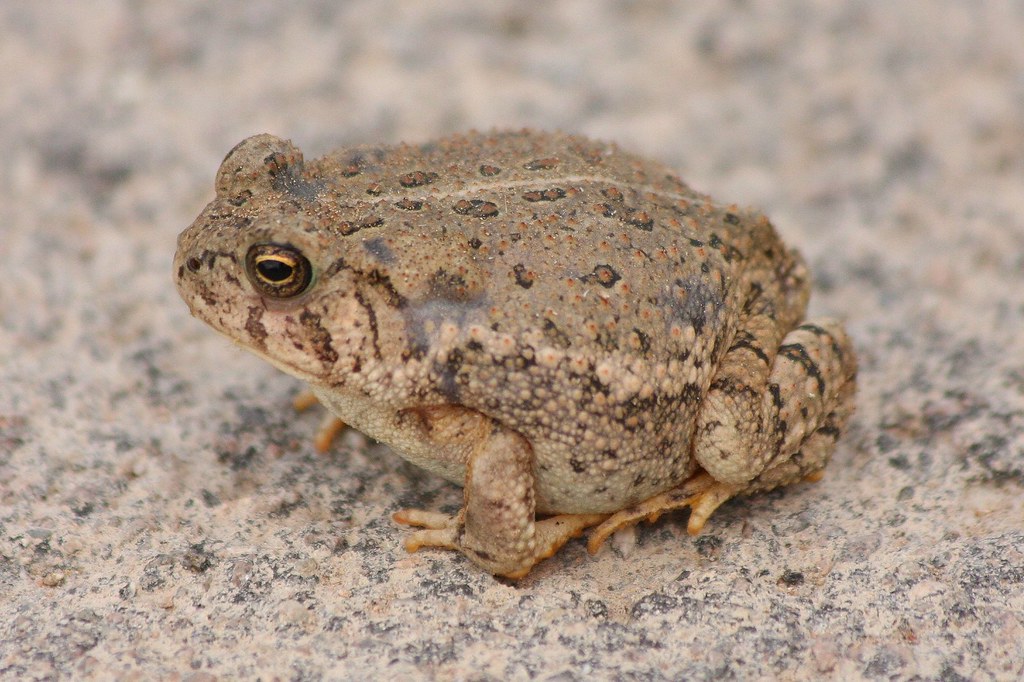
Photo 10
Woodhouse’s toad can vary in color from yellowish brown to greenish grey with a light stripe down the middle of its back and can reach up to 5″ in length with the males being smaller than females. These toads can be found primarily in deep soils in river valleys and flood plains. They burrow into soil to escape drought and cold. Woodhouse’s toad can be found statewide in Nebraska.

These toads breed from April to early September in marshes, rain pools and other areas lacking strong current. This toad’s call is a loud wahhhhhh lasting between 1-4 seconds and emitted several times a minute.
Plains Spadefoot (Spea bombifrons)

Photo 11
The Plains spadefoot is known for its vertically elongated pupil and markings similar to a hourglass on its upper sides. The plains spadefoot spends most of its life buried in the soil, but will emerge to breed after heavy rains in spring or summer. They can be found in sandhills, grassland and the plains throughout the state of Nebraska.

The call of the plains spadefoot is a brief snoring sound. Take a listen below.
Thanks for reading! Check out all of the United State’s native frogs and toads here.
Photo Credits:
Cover photo used by the creative commons license. Text was added. See Original photo by Hogs555 here.
- Photo from Wikimedia Commons used under the Creative Commons license. Photo taken by Brian Gratwicke. Original Photo Here.
- Photo from Wikipedia Commons used under the Creative Commons license. Photo taken by Brian Gratwicke. Original Photo Here.
- Photo from Wikimedia Commons used under the Creative Commons license. Photo taken by Brian Gratwicke. Original Photo Here.
- Photo from Wikipedia Commons used under the Creative Commons license. Photo taken by Fredlyfish4. Original Photo Here.
- Photo from Flickr Wikimedia Commons used under the Creative Commons license. Photo taken by Andrew Hoffman. Original Photo Here.
- Photo from Wikimedia Commons used under the Creative Commons license. Photo taken by Fredlyfish4. Original Photo Here.
- Photo from Wikimedia Commons used under the Creative Commons license. Photo taken by Fernando Mateos-Gonzalez. Original Photo Here.
- Photo from Flickr Wikimedia Commons used under the Creative Commons license. Photo taken by Andrew Hoffman. Original Photo Here.
- Photo from Wikimedia Commons used under the Creative Commons license. Photo taken by Galactor. Original Photo Here.
- Photo from Flickr Wikimedia Commons used under the Creative Commons license. Photo taken by J.N. Stuart. Original Photo Here.
- Photo from Flickr Wikimedia Commons used under the Creative Commons license. Photo taken by Stanley Trauth. Original Photo Here.
For more information:
Like “The Frog Lady” on facebook or follow aapanaro on instagram to get some sneak peeks into the frog lady’s frog room!

 The Frog Lady
I found a hyla veriscolor singing in Ralston Nebraska.
I know it to be so since I formerly lived in upstate new york and can tell apart the breeding calls. It was singing in a tree by an apartment complex with the classic slow warbly sound and by the pitch of the voice I can tell it’s been around.
I noticed on most websites there is no eastern greys reported really and I figured I would share that I found one as I wasnt expecting an old friend from the east to be heard again.
Gray tree frog, not Grey’s tree frog. typo.
oops.